
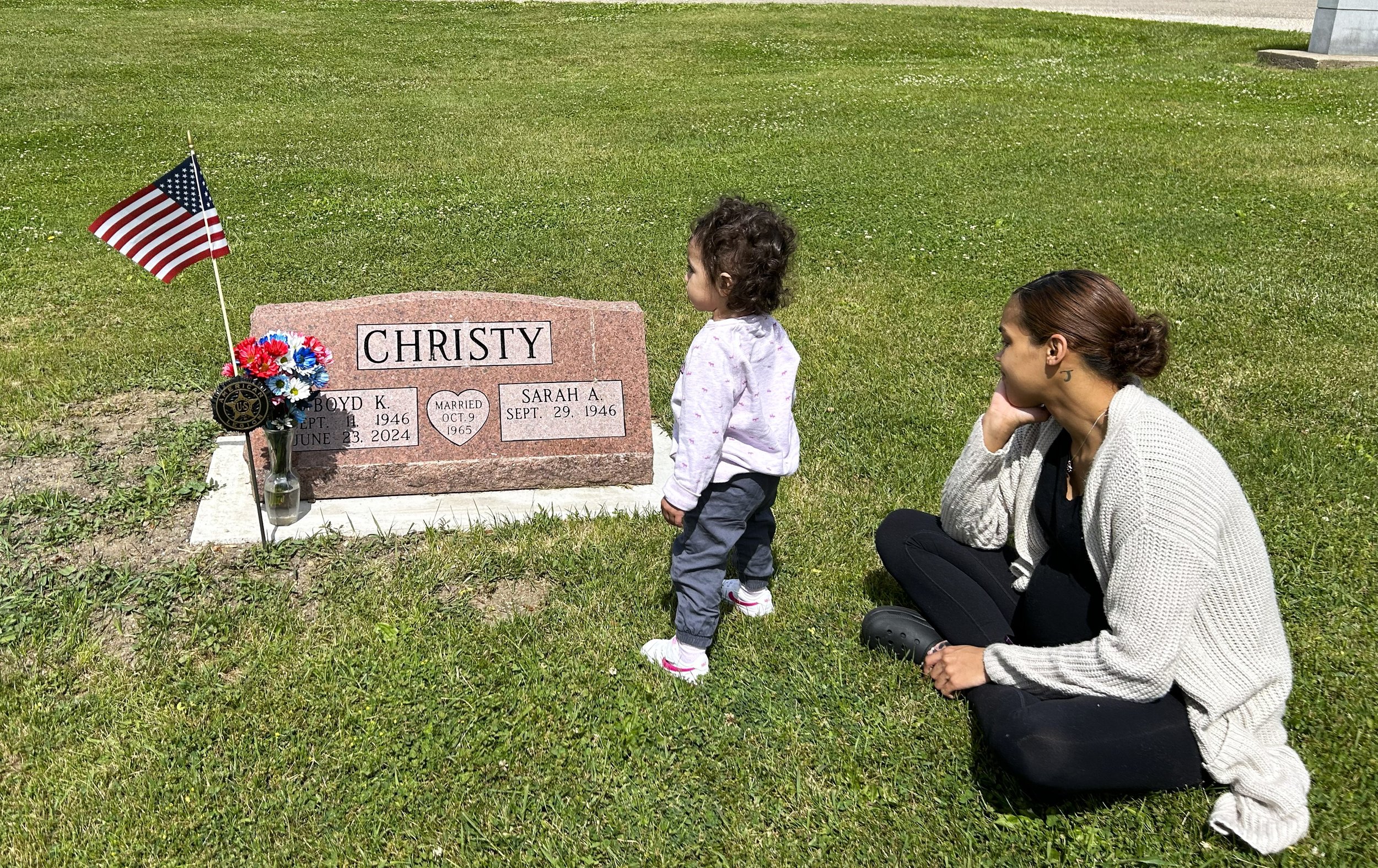
Grief
Grief is hard.
We can love fully and unconditionally but it is still hard.
We can put happy twists on moments but it is still hard.
We can laugh at circumstances but it is still hard.
We can be thankful for a prayer from a friend but it is still hard.
When we say that final good-bye, it is hard.
Life is hard, shall we share the journey?
I do not know the journey–frightening, exhausted, unchosen, rescue desired–no rescue, just tears and love—
I have always enjoyed words and stories and have used journaling as a way of processing my life. This is my story.
My husband of 58 years died in June, 2024. He had Alzheimer’s, I cared for him as he slowly faded away. At his services I wanted to tell the story of this good and wonderful man who had lived life well…
Beside writing a good story I, also, wanted to speak without wavering and without tears. I felt I did. I was proud of myself.
Relieved, I’d accomplished my goal, I turned quickly…missed the step and crashed to the ground. My friend said you were there then you weren’t, everyone gasped, I waved my hand as I lay on the carpet, yelling “I’m okay” in a less than graceful manner I stood up and returned to my seat.
That is what grief does to you, one minute you are strong and feeling together and the next you are lying on the ground needing to get back up on this journey of life.
My first encounter with deep grief was when my father died when I was twelve. I awoke in the early morning hours listening to soft voices murmuring in the living room. I felt a sense of foreboding. My mother came in and told my sister and I that our father had been killed in a car accident. He was only thirty-nine. I didn’t recognize the tragedy of the accident as much as I just knew my daddy was gone. This began my lifelong struggle with sleep. I was allowed to listen to my brother’s transistor radio to help me go to sleep, it had a leather cover and to this day when I smell leather I remember listening to music until I fell asleep.
My mother, in a desire to protect her children, rarely expressed her grief. I had no idea what to do with my emotions. I felt a sense of shame about my feelings so I locked my grief in a little box and finished growing up.
I was twenty when I was, again, smacked hard by grief. I came home from my second shift nursing job, went into my four month old son’s room to admire and kiss him before going to bed and found him dead of SIDS. The horror of that moment and the crushing grief that followed forever changed me. I would carry a loss of innocence and sorrow for the rest of my life. The pastor who spoke at our son’s services suggested God was crying as well. That was a comfort to me. I did my best to lock my grief in a bigger box feeling guilty for the big grief I tried to hide. I spent the next couple of years trying to use platitudes to keep functioning. It didn’t help.
Fifteen years later we were burying our second son, a fourth grader, who had died of cystic fibrosis. This time there was no box big enough for the grief I felt. We had two daughters, 11 and 6, who needed a mom so there was no box to be put away. We all muddled through our grief and tears. I didn’t feel confident in anything I said or did I simply kept going forward because I had no choice. God often met me in my struggle but generally at the last moment when I felt I had nothing left. I think there is a lesson
Learning to lean on God earlier rather than when you have reached desperation.
Often people did not acknowledge my grief. I understand they were uncomfortable. I remember driving in the car and my daughter saying, “If I say something about Rod are you going to cry.” I think that depicts a universal feeling we share. We don’t want to upset someone. Yet, the grieving need acknowledgement.
God, in his wisdom, has allowed me to use my grief in a positive way. I am an action girl. I wanted to use the hard earned wisdom from surviving the losses in my life. Today so many years later, I find great satisfaction and joy in supporting those who are grieving.
Caregiving Frustrations
“Slowly I turn, step by step, inch by inch.” This line from an iconic skit by Abbott and Costello popped into my head as it related to my journey as a caregiver. I would hear my husband quote it from time to time, mainly to our kids. Often caregiving is a slow, step by step, inch by inch life. Dressing, showering, walking, conversing all seem to take more effort and patience than they did a few years ago? There are times when the movement is upward but if I am being honest those days are few.
The quote had popped into my head when my husband, who has Alzheimer’s, went to a doctor's appointment. The nurse who used to see him regularly hadn’t seen him in over a year. I felt her sympathy as she recognized his slow steady decline. She asked me how I was doing.There is a tension between acknowledgement and sympathy. I don’t want to be pitied but I do like being acknowledged my life is hard. Early in our Alzheimer’s adventure, the doctor reminded me that while he was doing well, this is a progressive disease. Reminding me it wasn’t going to be a quick or easy journey.
An easy pitfall for me is to slide down the slippery slope of self pity. Because I have been given the gift of overthinking I can sit at the bottom of the slope for a while analyzing our life. Is he forgetting even more? Is his stamina for walking getting less? Can I maintain our life together? Will there be enough money? What if? I can expend a lot of energy thinking. Yet, I want to experience the joy I might find each day, accepting this hard road we have to travel.
Caregiving has always been part of my life. Growing up in a small town with elderly grandparents, we cared for others because they needed care. Mainly family, friends or people we knew in the small town where I lived. When I completed high school, the main career options presented to girls were nurse, teacher or office worker. I went off to nursing school. I was satisfied with my choice and enjoyed nursing but my main goal was getting married and being a stay at home mom. Nursing was a good match and I enjoyed it for many years. Caring for others and making a difference in their lives was important to me and I found it very rewarding.
I married but found some alterations in my dream as we met with some bumps in the road. Our first son died of SIDS, then my husband was sent to Vietnam, was wounded and spent a year in a military hospital. We kept going and came home and started our life a second time. We had a daughter then felt a calling for adoption of a child that might need a home. We were thrilled to adopt our kids. This moved me into adding more caregiving needs than might have been anticipated. Our first adopted son was diagnosed with an incurable genetic disease, cystic fibrosis. Next we adopted a baby girl with a cleft lip and palate. My life was set on a caregiving path with all the joys and challenges rolled up in a good life.
In this space I will share with you, my reader, the stories of caregiving. I want to be open and honest as I share the good, the bad and the hard. Every night as I get my dear husband into bed he says to me, “ thank you for taking care of me” and “get some rest.” I know my fatigue and frustration, while annoying, are just part of loving someone.
Caregiving boredom & repetition
Nine PM is Boyd’s bedtime. I have imposed that bedtime, actually I would make it 8:30 if it wasn’t for his resistance. He can no longer follow a tv show, he can no longer carry on a conversation unless I introduce the subject and move it along, he cannot read, he cannot walk alone, he cannot do a simple task. He sits in his chair, watching me and the dog. I think in his mind he thinks he is supporting me by being present. I suppose we never shed all the images of ourselves we hold from our youth.
I want him to go to bed at 8:30. There is no way he will. I’ve tried passing it off as bedtime but invariably he’ll ask and I cannot lie. So much of our connection is gone. I don’t want him to discover me lying. Ultimately it doesn’t matter.
But there are still the final nighttime chores I have left to do: locking doors, making the coffee, clearing up the clutter, making the home health list for tomorrow. My life is repetition, repetition, repetition. It is Groundhog Day caregiving.
The phone rings. My granddaughter is sobbing. She was over earlier to help me out with some chores. (she needed gas money). I was so happy for her to take care of some things. She has been close to us because she lived with us part of her teens. Papa has always been her anchor. Loving her, disciplining her, teaching her, always her cheerleader, Papa is fading and the fading will continue, and the grief and loss will continue, little by little, we will lose him.
She talks about his fading and his illness. She says, guiltily that maybe it would be better if he died quickly and then wishes it back because at least he is still here. There are so many emotions, so much pain and grief. I sympathize, reassure her, and validate her feelings. I tell her how much I love her. We are together in our grief.
Who do I talk to? Who sees my pain, exhaustion, grief? I’m Mom. I’m Grandma. I’m Daughter. I’m a Woman of Faith. I want to crumble, Sarah crumble? Unheard of.